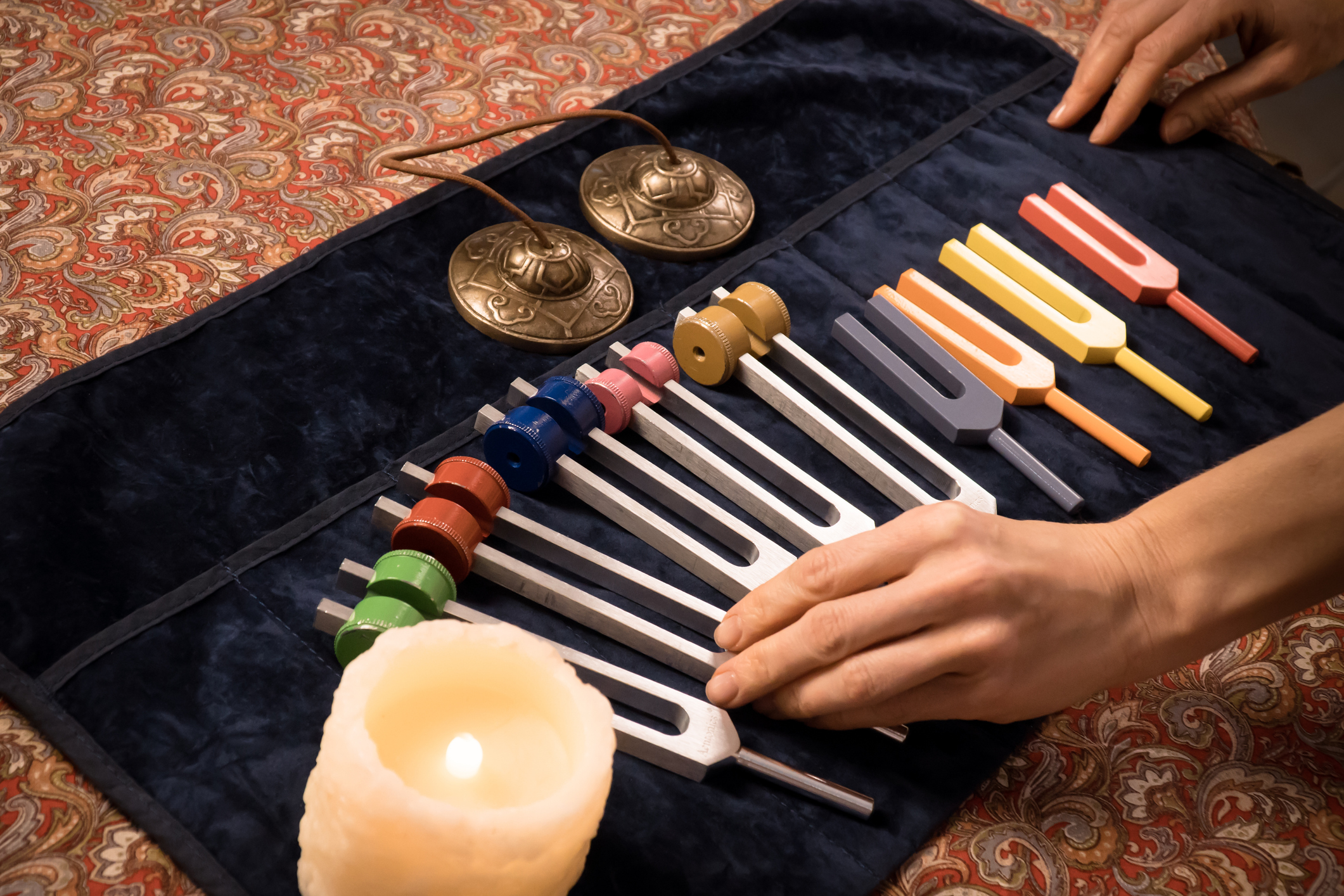
John Beaulieu’s discovery, and much of the modern science of sound therapy, began with an argument over a subway token. It was 1973 and Beaulieu was a young psychologist who’d just finished graduate school with degrees in both psychology and music. He’d been fortunate enough to study with leading practitioners in both camps: avant-garde composers like John Cage and Iannis Xenakis, with their electroacoustic music, and psychiatrists like R. D. Laing with his alternative approaches to treatment, which expanded his academic background in Jungian analysis.
Beaulieu’s crop of brown hair and baby-faced looks belied a serious scientific bent that sought to understand the secrets of the universe from both the scientific and the artistic angle. At the time he was working at Bellevue Psychiatric Hospital on First Avenue in Manhattan, carrying out experiments to heal what would later be labeled post-traumatic stress disorder, and in the corner of his laboratory downtown in New York University was a little anechoic room on wheels, a chamber “without echoes,” designed to shield out echoes or reflections of sound, electromagnetic waves, and other types of energy from the surroundings. In this rarified space, only sound made by someone or something sitting within its walls could be heard.
John learned from his fellow psychologists that the chamber had been installed for a variety of experiments, with whispers many years later about CIA involvement in interrogation and desensitization techniques, and possibly even LSD. But by the time he got there, it just took up space in the corner of the lab for no apparent reason, largely because it was too big to move anywhere else.
John immediately recognized its function; John Cage had told his students he’d sat in one to listen in on the sound of his nervous system. Beaulieu decided to make use of the anechoic room in spare moments to listen to the sounds coming from his own body, and was particularly interested to see if he, too, could tune in to his nervous system.
After meditating for a few moments in total silence and utter darkness, he would then quietly listen, only to find, as many others had in that kind of space or even during a night free of environmental noise, that a nervous system at work generates a tiny high-pitched whine. It was a little like an old television set with a cathode-ray tube, constantly emitting a tiny shrill sound in the background. People with tinnitus can often hear a similar sound in their heads, although in that situation, it’s cranked up to full blast.
He’d been carrying out the experiments for a month and keeping careful records of what he’d heard. One morning during his commute he had a heated argument with a toll booth employee in the New York subway over whether he’d paid his fare. He’d left the subway shaken by the argument, but thought nothing more about it once he arrived at his laboratory.
During a spare moment he entered the sound-free chamber, but this time, he could hear his nervous system making a screeching noise, a bit like fingernails scraping down a blackboard. Compared to its usual sound, his nervous system was screaming some fifteen times louder than normal. John was shocked. Had he not carried out his previous experiments and regularly recorded the baseline sounds, he never would have known the enormous effect that the argument had had on his body.
It was as though he were a violin out of tune. And then another thought came to him. What if I can tune my nervous system the same way you tune a piano? After all, the nerves of the body are just another kind of string.
As it happened, there was a music store downstairs, just a few buildings over. Beaulieu ran downstairs to it and asked the shop assistant for two tuning forks. He knew which particular frequencies to ask for because his former teacher Xenakis, the Greek composer, had made sure his students had a thorough grounding in the mathematics of music and musical intervals. John was looking for tuning forks for middle C and G, because he believed he needed a certain mathematical ratio of the frequencies: 3 over 2, the classic interval of a perfect fifth, consisting of notes that are seven semitones (black and white keys), or five white keys, apart.
John purchased the forks and then headed back into the chamber. He tapped the two tuning forks on his knees, brought one of them to each ear and held them there. Within seconds, the screeching completely stopped. He felt his shoulders drop and a wave of relaxation come over him. The steady hum of his nervous system immediately returned to normal.
How many people in the modern world are walking around completely unaware that their nervous system is shrieking like his was, he wondered. If it was constantly exposed to these kinds of stressors, the autonomic nervous system would remain completely out of kilter, bringing on a host of physical and mental disease.
The problem wasn’t the stress per se but staying in that state and not knowing how to calm the aftershocks to the nervous system. He’d only been able to get back to baseline with the aid of the tuning forks. But an enormous possibility opened up to him: He could heal people’s nervous systems—and possibly a host of other conditions—just by retuning them to the right frequency.
John began experimenting with his patients, a practice tolerated by the psychiatrists at Bellevue and written off as a method of entertaining severely troubled people.
One early recipient was Joe, a thirty-four-year-old fashion retailer from New York City, who’d been treated elsewhere without success for depression, anxiety, and panic attacks. Joe had experienced a good deal of childhood trauma. He’d been sexually molested from age seven through twelve by an older distant cousin. Joe was both terrified of and attracted to the excitement of these secret encounters, but then felt intense shame about them, leading to deep self-loathing. He constantly worried that people would discover his darkest secret and ultimately reject him in disgust.
When Beaulieu first saw Joe, he’d complained of a host of symptoms, including depression, severe anxiety, insomnia, nausea, weakness, and general pains, plus daily panic attacks, triggered by news that his current boss, formerly a personal friend, was spreading false rumors about him to the staff.
His anxiety was so great that he’d had to be put on antidepressants and tranquilizers, but the drugs weren’t really helping. John tried playing some tuning forks on Joe, including the Otto 128, a tuning fork meant to be placed on the body using a protocol of 128 hertz, the interval between C and G that he’d developed for anxiety. By the end of the session, Joe said that he’d never felt as relaxed in his life. And to his amazement, all his physical symptoms had disappeared.
In the next few sessions, Joe always arrived in an extremely agitated state, and John would combine sound therapy and psychological treatment in his sessions. Within five months, Joe’s symptoms disappeared, and he was able to come off all medication and ultimately seek other, happier employment. The sound therapy set the stage for other interventions to work
John began using his tuning forks for other patients with different issues. Edward, a thirty-nine-year-old contractor from upstate New York in a trial separation from his wife of six years, had been suffering from depression, daily panic attacks, insomnia, and general restlessness, which interfered with his ability to focus on his work. He’d also started drinking too much. He couldn’t understand why his wife wanted the separation, since he felt he was a good provider, but did admit that he’d been working excessively long hours.
During his first session, John held the tapped C and G tuning forks to Edward’s ears and held them there for two minutes. When he was done and Edward sat up, John noticed that his entire body’s alignment and his facial muscles had greatly relaxed, as though a great weight had been lifted. When he stood, he even appeared taller.
“I have been exaggerating the situation more than necessary,” he said. “I love my wife and was overwhelmed with the responsibility of taking care of her. I am a good person who cares deeply. I need to improve my communication skills with my wife and collaborate on addressing our tasks together.”
John gave Edward C and G tuning forks to take home. With the exception of one panic attack a week later, sorted out in a few minutes with his tuning forks held up to his ears, Edward’s condition continued to improve.