I just read about a Italian psychology experiment that gives us all a key to what to do about these fragmented and worrying times in our towns, cities and neighborhoods.
The experiment was carried out in late 2024, when a group of Italian psychologists decided to see if they could shake up things in a subway in Milan.
One of the experimenters, disguised as a heavily pregnant woman and wearing a large prosthetic belly, boarded a crowded subway. There were no seats left and as they rode along, only a third of passengers acknowledged her in any way or offered her a seat.
One of the other scientists riding along as a fellow passenger observed and took note of any help offered.
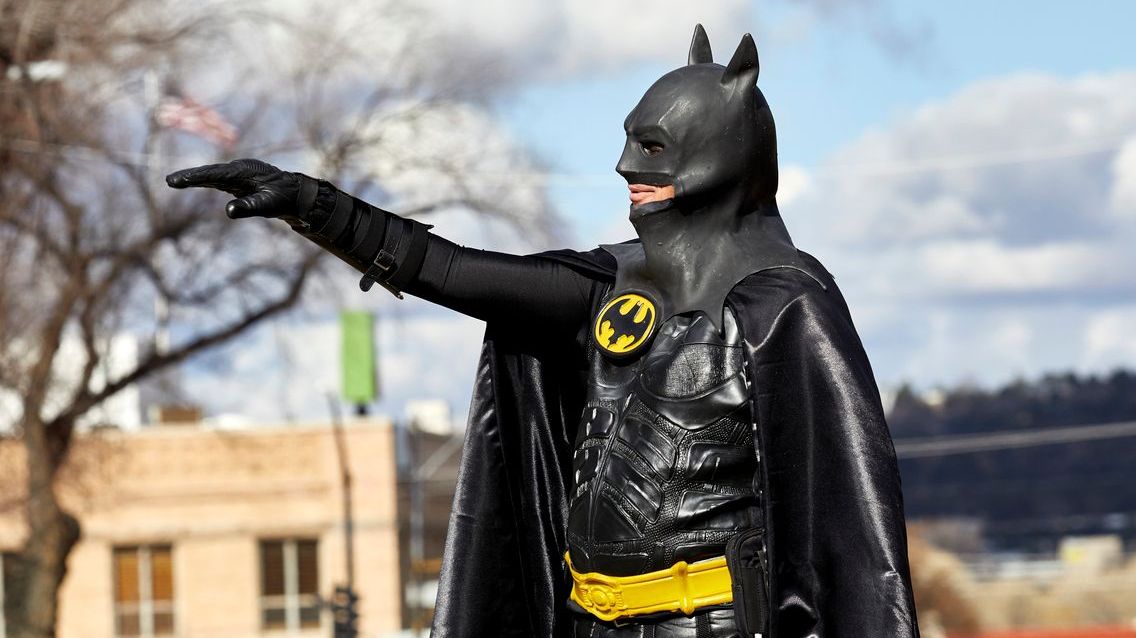
They tried the experiment again, but this time, after the pregnant woman boarded the train, a man dressed in a Batman costume entered the train from another door three yards away. Although he’d omitted the part of the mask covering his face, so as not to scare the passengers, the signature costume – the cape, the logo and the pointed cowl – immediately identified him as the superhero.
Although Batman did not approach or interact with the pregnant woman in any way, this time more than two-thirds of the passengers offered her a seat.
The scientific team, from the Department of Psychology at the Università Cattolica del Sacro Cuore in Milan, ran the experiment more than 100 times and each time got a similar result.
The psychology team, concluded that the sudden empathetic reaction, transforming the indifference of a crowded urban subway into a model of ‘pro-social’ behavior, as they called it, all had to do with shaking people out of their usual inward focus and automatic behavior and into a state of mindfulness – acute awareness of the present moment.
It was completely understandable since the lead author, Francesco Pagnini, has long been a student of mindfulness. But it was odd that they’d concluded this when some 44 percent of the subway passengers hadn’t even noticed Batman.
I take a completely different view. Batman is the very embodiment of an ‘upstander’ – a superhero who possesses a strict moral code to clean up Gotham City and assist its citizens. His arrival raised the tone of the subway, jolting people out of their self-focused stupor and reminding them of the human social contract to do unto others. Sometimes, in these self-obsessed times, people need a little reminding, and there is nothing like a superhero to do so.
The prevailing view of the mentality of bystanders that has existed since 1964 was formed after brutal attack lasting over an hour, when twenty-eight-year-old Kitty Genovese was repeatedly stabbed while thirty-eight of her neighbors in Queens, either witness to the attack or within earshot of her screams, reportedly did nothing to help.
Genovese’s murder and her neighbors’ indifference provoked endless headlines and spawned a great deal of social psychological research into what has been called “the Bystander Effect”: why people stand by and do nothing when another person is in trouble.
At the time, the research concluded that, if people are clustered together in some sort of group, there is a “diffusion of responsibility”; people are less likely to help than they would if they were alone because they wait until someone else volunteers to help first.
Many studies challenge this assumption (and the Genovese Syndrome has since been discredited as a case of bad reporting), by showing that in experimental or real-life scenarios, there are always Good Samaritans ready to help.
But the Batman study demonstrates something even more important: sometimes we need the presence of a Superhero – someone who stands for truth, justice and all those good things – to bring out the altruist in all of us.
And boy do we need that now.
Plenty of evidence shows that our emotions are highly contagious, even unconsciously so. Just one altruist – even a symbolic one – can cause an epidemic of good will.
Let that altruist be you. Do just one superhero action and watch how it changes the dynamic in the neighborhood around you and eventually your town or city – maybe even the world.