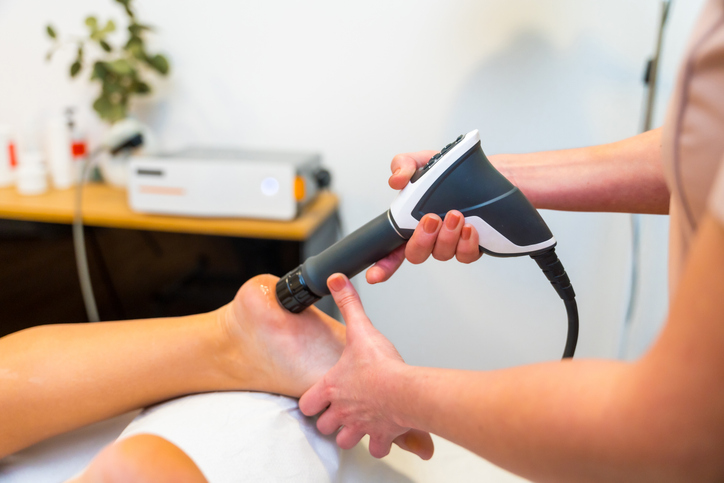
Of all the alternative treatments out there, one of the most unlikely is something called shock wave therapy, and there’s a simple reason why: It uses a blast of sound waves to heal.
Until now, sound has been the Cinderella of energy in medicine, unleashed when some sort of mechanical force causes a vibration, creating a wave through air or water. But since this energetic output is far lower than all other energies, its purpose has been understood to be limited largely to communication or entertainment.
But recently scientists have been experimenting with sound waves as a healing agent. Sound waves are measured in hertz, the speed at which a sound wave, represented as a sideways S, completes one full cycle of amplitude up and down.
Decades ago, doctors began using sound waves to break up kidney stones and to visualize a growing fetus. Anything beyond our capacity to hear is called ultrasound, and it’s used for both of these purposes.
But in 2004 a group of researchers at the University of Michigan began exploring the use of lower sounds with a higher amplitude to destroy unwanted tissue. They coined the method as “histotripsy,” from the Greek histo, which means “soft tissue,” and tripsy, which means “breakdown.” A bit like lithotripsy, which uses high-frequency sound waves of 23–350 kilohertz (23,000–350,000 hertz) but at high pressure to smash kidney stones, histotripsy uses ultrasound as a weapon, but on the cellular level, to destroy dangerous tissue.
And unlike standard ultrasound, which uses high-intensity, continuous bursts of sound waves for a long time to heat tissue, histotripsy employs short bursts to minimize heating. Its effectiveness depends on “acoustic cavitation” from gases inside the body’s tissues, the creation of tiny bubble clouds that expand and quickly collapse. The intense strain of this rapid change in pressure causes such stretching and shrinking of targeted cells that they explode into debris, a bit like they’ve been struck by a laser in Star Wars.
As brutal as it sounds, the Michigan researchers discovered histotripsy triggers an immune response to cancer that is far gentler than that caused by conventional cancer treatments. With chemotherapy and radiotherapy, the entire cancer cell, including proteins known as tumor antigens, is destroyed, whereas histotripsy simply opens up cancer cell walls to reveal the antigens, alerting the immune system to their presence and enabling it to kill the cancer on its own.
In preliminary histotripsy tests on mice and rats with liver cancer, the tumors were completely destroyed even when only half the mass was targeted by the sound waves. The immune response stopped the spread of the cancers in more than 80 percent of cases. In fact, the body’s immune response wasn’t just limited to the area the histotripsy targeted; it spread throughout the body.
Even more amazingly, when the Michigan researchers transferred the cancer cells exposed to the sound waves into other animals, these also triggered an immune response, suggesting the sounds had created some sort of lasting healing-resonant effect in living cells.
“Injecting the debris into a second mouse had almost a vaccine-like property,” Zhen Xu, the lead Michigan researcher, noted in the press release about their discovery. “Mice that received this debris were surprisingly resistant to the growth of cancers.”
Lithotripsy is called “shock wave” therapy because the sound frequencies, above our capacity to hear, are created and delivered by a continuous stream of pulsing waves; 90 waves per minute is considered optimum to break up kidney stones.
But now medicine has found other uses of shock wave therapy: treating muscular conditions and pain or minimizing scars, and much more. It’s been shown to improve bone mineral density, and speed healing of bone fractures, tennis elbow, carpal tunnel syndrome, frozen shoulder, meniscus tears, chronic low back pain, bone regeneration in dental implants, gum disease, and even various brain conditions like dementia.
One study found that Alzheimer’s patients treated with shock wave therapy improved speech, memory and mood, while Parkinson’s patients given shock wave treatment enjoyed over 50 percent improvement.
It’s clear that sound frequencies are the medicine of the future, delivering powerful effects with far fewer side effects than often brutal drugs or surgery.
We’re just beginning to recognize the potential of this Cinderella energy and that sound waves of all speeds can have a dramatic effect on our biology, whether to destroy something unwanted or to fix something that has stopped working well.
It’s definitely time to invite Cinderella to the ball as a legitimate—and far safer—way to heal.
Want to read more about shock wave therapy? It will be published in our magazine What Doctors Don’t Tell You next week: www.wddty.com